



Birth time rectification is the astrological process of finding or correcting your exact time of birth. An astrologer starts from a time window, draws up the chart for each possible minute and tests those charts against the dates of real events in your life: a marriage, a move, the birth of a child, a new job. The time whose chart best matches how your life has actually unfolded becomes your rectified birth time.
On this page
What is birth time rectification?
Every birth chart is a map of the sky for one minute and one place. Your birth date tells us where the Sun, the Moon and the planets were that day. Your birth time tells us something just as important: which sign was rising on the eastern horizon, where the Midheaven stood and how the sky divides into the twelve houses that astrologers read as the areas of your life.
When that time is unknown or uncertain, the foundation of the chart is uncertain too. Rectification, from the Latin rectificare, “to set right”, is how astrologers rebuild it. The word sounds technical, but the idea is simple: if the chart is right, the big moments of your life should show up in it at the right times.
Astrologers rectify charts in three situations:
- when no birth time is known at all;
- when only a rough time is known, such as “early morning” or “around lunchtime”;
- when a recorded time exists but the chart doesn’t seem to describe the person or the timing of their life.
Why a few minutes change your whole chart
The Sun spends about a month in each sign, so everyone born in the same month shares a Sun sign. The Moon changes sign every two and a half days. But the angles of the chart, the Ascendant and the Midheaven, turn with the Earth itself: they pass through all twelve signs every single day.
- The Ascendant (rising sign) moves about one degree every four minutes. Depending on the sign and how far north or south you were born, a sign can rise in under an hour or take more than three; on average it changes every two hours.
- The houses are counted from the Ascendant. Shift it by one sign and every house shifts with it, so the same planet can move from your 7th house of partnership to your 6th house of daily work.
- The Midheaven, the top of the chart linked with career and reputation, turns just as fast.
- The Moon moves about half a degree an hour. If you were born close to a change of sign, an hour can decide your Moon sign.
There is a second reason the minute matters. Many forecasting techniques move the chart forward symbolically at about one degree for each year of life. Because the angles also move about one degree every four minutes, a birth time that is four minutes off can shift the timing of a forecast by about a year. Twenty minutes off, and a forecast built on the angles could point to the wrong year by around five years.
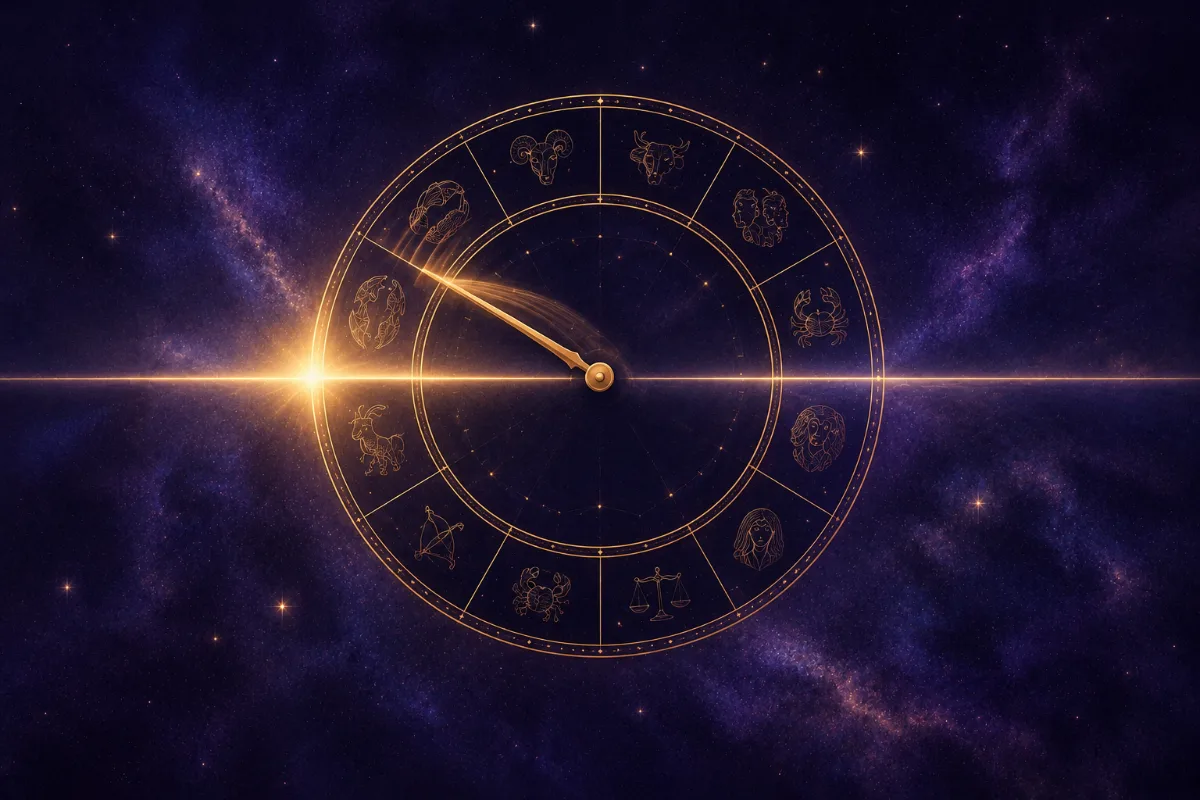
Same day, two hours apart
Take two people born in the same hospital on the same day, one at 8:00 in the morning and one at 10:00. They share a Sun sign, very likely a Moon sign and the signs of every planet. But their rising signs will probably differ, so every house in their charts is shifted by one sign. When Jupiter enters a new sign, it may cross one person’s 10th house of career and the other’s 9th house of travel and study. Same sky, same horoscope headline, two different years.
Is the time on your birth certificate exact?
Often it is close. Sometimes it is not. A recorded birth time is a note made by a person in a busy room, and several things can move it away from the true moment:
- Rounding. Times are often written to the nearest five, fifteen or thirty minutes, or to the hour. A time ending in :00 or :30 deserves a second look.
- Recording after the fact. The time may be filled in minutes later, once the baby and the mother have been looked after.
- Which moment counts. Astrologers traditionally use the first breath; a record may note the delivery, the cutting of the cord or simply when the paperwork was done.
- Memory. Without a document, the time often comes from a parent’s memory decades later: “before dawn”, “just after lunch”.
- Clocks and time zones. Historical daylight saving rules, war time and changes of local time are easy to get wrong when the chart is calculated.
Where you were born matters too. In some countries the birth time is printed on the birth certificate; in others it is kept only in hospital files, a baby book or the family’s memory. A planned caesarean birth, or a time written down by a parent with a watch in hand, tends to be more reliable. Even then, a careful astrologer treats a recorded time as the centre of a window, not as a fact.

Three starting points: known, approximate or unknown time
You know your time to the minute
You have the best starting point. Rectification is then a check: a light pass to confirm that the recorded time fits your life. If it does, nothing changes. If it doesn’t, the astrologer looks a few minutes either side.
You know roughly when you were born
“Around midnight”, “early afternoon” or “during the night shift” gives a window of one to four hours. This is the most common case and a workable one: inside it there are usually only one or two possible rising signs, and your life events decide between them.
You don’t know your birth time at all
Then the window is the whole day and all twelve rising signs are possible. Rectification can still work, but it needs more events and more patience. Until you have a time, your Sun sign, the signs of most planets and a range for your Moon can still be read; what is missing is the rising sign, the houses and the angles.
Before any calculation, ask: a parent, an older relative, the hospital where you were born, a baptism or other religious record, a baby book. Even “it was still dark” or “the doctors had just changed shifts” narrows the search.
How rectification works, step by step
- Set the window. Start from the recorded or remembered time and decide how far it could be off: a few minutes, an hour or the whole day.
- List your life events. Write down 10 to 20 events with the most exact dates you have. An exact day is best; a month and year still helps.
- Draw up candidate charts. Calculate the chart for each possible time in the window. Often the first question is simply which rising sign it is.
- Test the timing. For each candidate, check whether your events coincide with strong movements to the angles and house rulers of that chart: transits, progressions and directions, explained below.
- Look for agreement. One lucky match means little. The right time is the one where several events and several techniques point to the same few minutes.
- Test it forward. A rectified chart makes claims about the future. If it keeps describing the next events of your life, confidence grows; if it doesn’t, the work isn’t finished.

Which life events help most
Astrologers prefer events that are sudden, clearly dated and life-changing. Long, gradual processes are hard to pin to a day.
| Event | Why it helps | What astrologers check |
|---|---|---|
| Marriage, engagement or the start of a serious relationship | Partnership belongs to the 7th house and the Descendant | Descendant, ruler of the 7th house, Venus |
| Birth of a child | A clear date and a lasting change in daily life | 5th house, Moon, Jupiter |
| Death or serious illness of a parent | Family and roots are tied to the 4th and 10th houses | IC–MC axis, Saturn |
| Moving home or emigrating | A change of home is tied to the 4th house and the IC | IC, ruler of the 4th house, Uranus |
| New job, promotion, dismissal or a business launch | Career is the domain of the Midheaven | MC, ruler of the 10th house, Saturn, Jupiter |
| Accident, surgery or a sudden health event | The body is linked with the Ascendant and the 1st house | Ascendant, Mars, Uranus |
| Graduation, long study or studying abroad | Higher learning belongs to the 9th house | 9th house, Jupiter |
| Divorce or separation | The end of a partnership, again through the 7th house | Descendant, Saturn, Uranus, Pluto |
Keep the dates as exact as you can and mark the uncertain ones. A wrong date does more harm than a missing one.
The main techniques astrologers use
Astrologers combine several timing techniques. None is enough on its own; their value lies in agreeing with each other.
Transits to the angles
The slow planets, Saturn, Uranus, Neptune and Pluto, take weeks or months to cross a degree. When a major event coincides with one of them touching the Ascendant, Midheaven, Descendant or IC of a candidate chart, that candidate gains weight. Because the angles move one degree every four minutes, a handful of such matches can narrow the window quickly.
Secondary progressions
In secondary progressions, each day after birth stands for one year of life. The progressed Moon, Ascendant and Midheaven move slowly through the chart, and their contacts with natal planets are compared with the timing of your events.
Solar arc directions
Every point in the chart is moved forward by the same amount as the progressed Sun, about one degree a year. When a directed planet reaches an angle at the age an event happened, it supports that birth time. Moving the birth time by four minutes moves those dates by about a year, which makes solar arcs a favourite rectification tool.
Primary directions
One of the oldest timing techniques, built on the daily rotation of the sky. Primary directions are so sensitive to the birth time that they can separate candidate times only a few minutes apart, as long as the events are precisely dated.
Vedic approaches
In Indian (Jyotish) astrology, rectification also checks whether events fall in the right planetary periods (dashas) and looks at divisional charts: the Navamsa (D9), whose rising sign changes about every quarter of an hour, and the finely divided D60, which changes every couple of minutes. Astrologers of the Krishnamurti Paddhati (KP) school use sub-lords and ruling planets for the same purpose.
Older and supporting methods
Traditional texts describe the prenatal epoch (the “Trutine of Hermes”) and the Animodar, rules that link the birth chart to the moment of conception or to the previous lunation. Many astrologers also compare the rising sign with a person’s appearance and temperament. These checks can help choose between two rising signs, but on their own they are rough guides, not proof.
How accurate is rectification?
It depends on the starting window, on the number of well-dated events and on the astrologer. With a narrow window and a dozen clear events, astrologers often aim for a result within a few minutes. With no time at all, settling on the right rising sign is already a real achievement.
It is also fair to say what rectification is not. There is no independent scientific evidence that it can recover a birth time to the minute, and astrologers working on the same chart sometimes arrive at different times. A rectified time is a reasoned estimate, and the honest way to treat it is as a hypothesis to be tested.
That is exactly the idea ReYep is built on.
The ReYep approach: test your chart against your life
Classic rectification looks backwards: you remember a handful of big events, sometimes decades later, and the astrologer fits a chart to them. ReYep turns the process around and works forwards.
- Dated predictions, published in advance. Every month we publish predictions for each sign, each tied to a real astrological event and a date.
- Your ratings, recorded as life happens. Once the date has passed, you rate from 0 to 10 how far the prediction came true for you and can note what actually happened.
- A record that grows with you. Month after month, these dated ratings and notes show when the sky’s events showed up in your life: the same kind of evidence rectification relies on, written down at the time instead of remembered years later.
Together with your birth date, time and place, that record is what ReYep is being built around: narrowing down your real birth chart, recognising your own pattern, meaning which kinds of events land for you and which pass you by, and writing readings for you rather than for everyone who shares your sign. You can see how predictions are written and counted on our methodology page.
Start your record today
Create a free profile, add your birth details, even an approximate time, and rate the predictions for your sign as their dates pass.
How to prepare for a rectification
Whether you work with an astrologer or start your own record on ReYep, the preparation is the same:
- Find the best source for your time: birth certificate, hospital record, baby book, a parent’s diary. Note how sure you are.
- Write down your window: “between 6:00 and 7:30”, “at night”, “unknown”. Be honest about the uncertainty.
- Collect 10 to 20 dated events from different areas of life: relationships, children, home, work, health and family.
- Add the exact day wherever you can and mark estimates with a question mark.
- Check your birthplace: the town or city, not just the country, because the location changes the angles too.
- Keep recording. New events are the best test of a rectified chart, and rating this month’s predictions on ReYep is a simple way to log them.
Key terms
- Ascendant (rising sign)
- The sign and degree rising on the eastern horizon at your birth. It starts the 1st house and moves about one degree every four minutes.
- Midheaven (MC)
- The highest point of the ecliptic in your chart, linked with career and public life. Its opposite point is the IC.
- Houses
- Twelve sections of the chart, counted from the Ascendant, each describing an area of life.
- Transit
- The current position of a planet compared with your birth chart.
- Secondary progression
- A symbolic method in which each day after birth stands for one year of life.
- Solar arc
- A method that moves every point of the chart forward by the same arc as the progressed Sun, about one degree a year.
- Rectified birth time
- The birth time an astrologer arrives at by testing candidate charts against dated life events.
Frequently asked questions
What is birth time rectification in astrology?
Birth time rectification is the process of finding or correcting an exact birth time by comparing candidate birth charts with the dates of real events in a person’s life. The time whose chart best matches those events is used as the rectified birth time.
Can I rectify my birth time myself?
You can do the groundwork yourself: find the best source for your time, set a window and list your dated life events. Testing candidate charts with transits, progressions and directions takes astrological software and experience, so many people work with an astrologer for that step.
How many life events are needed?
Most astrologers want at least five to ten clearly dated events from different areas of life; 10 to 20 is better. A few precise dates are worth more than many vague ones.
What if I don’t know my birth time at all?
You can still read your Sun sign, the signs of most planets and a range for your Moon. To find the rising sign and houses, ask your family and check hospital or religious records first. If nothing turns up, rectification can start from the whole day, though it needs more events.
Is the time on a birth certificate accurate?
Often it is close, but it may be rounded to five, fifteen or thirty minutes or written down after the birth. Astrologers treat a recorded time as the centre of a window rather than an exact fact.
How accurate is rectification?
With a narrow starting window and many well-dated events, astrologers often aim for a few minutes. Results can differ between astrologers and are not scientifically proven, so a rectified time is best treated as an estimate to test against future events.
Why does my rising sign matter so much?
The rising sign is where the twelve houses begin. Change it and every house moves, which changes where each transit lands in your life and how a forecast applies to you.
Does ReYep rectify my birth chart?
Not automatically yet. Today your free profile keeps your birth details and a dated record of your ratings and notes. Using that record to narrow down your real chart and personalise your readings is what we are building toward.